The More Equipment, More Progress Assumption
The more exercise equipment, more progress assumption can leave a room crowded. Match each purchase to an activity, a real obstacle, and a workable storage plan.
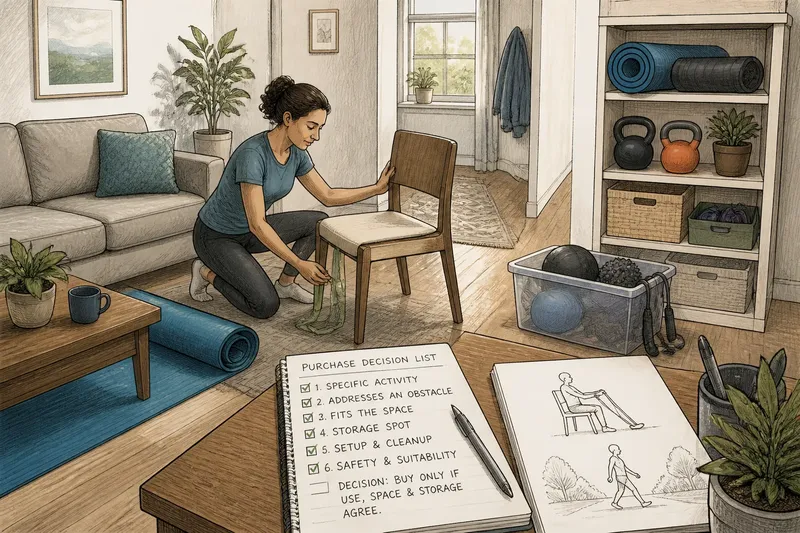
The more exercise equipment, more progress assumption can turn an open corner into a storage problem. Before buying anything, name the activity you plan to do and the obstacle a new item would remove; that distinction keeps equipment tied to a use rather than to an imagined future routine.
More exercise equipment does not automatically mean more progress
Exercise equipment can expand the ways you move, but owning more of it does not decide which activities you practice. A useful item has a clear role in a routine; an unused item may simply make the room harder to use.
That role can be practical rather than ambitious. A chair may make a seated movement session possible in a small room, while a resistance band may suit an activity that calls for adjustable resistance. The point is not to collect tools, but to identify a tool that fits a particular plan.
Choose equipment around the activity, not the other way around
Describe the activity without naming gear: “I want to practice standing balance near the kitchen counter” or “I want to take a walk after lunch.” Then consider whether anything is missing for that activity to happen comfortably in the place you have chosen.
This order matters because a purchase can quietly dictate what you do. A bench bought without a specific use may leave you looking for exercises to justify it; an activity-first decision keeps the movement itself at the center.
Match exercise equipment to the space you actually use
Consider the whole setup, not only the dimensions of an item. A mat needs clear floor around it for the movements planned, and a folding platform is only convenient if opening and storing it are easy in the room where you exercise.
Shared spaces introduce another consideration: whether equipment can be put away without a long reset. If moving a table or clearing a hallway is already part of the plan, decide whether that effort is manageable before adding gear that requires still more rearrangement.
Imagine you want to practice gentle floor mobility beside a sofa, but a coffee table blocks the open patch. You move the table and try the activity without buying anything; if the space then works but the floor feels uncomfortable, a mat may address that specific issue, while a bench would not.
Plan around the room you have, including the path to storage.
Use a purchase decision list that leads to a choice
Before checkout, write down the activity, the item’s intended job, and where it will live. Then check each point below and follow the decision attached to what you observe.
- Check whether you can name a specific activity for the item; if you can, keep considering it, but if you cannot, postpone the purchase and choose an activity first.
- Check whether the item addresses an obstacle you have encountered; if it does, compare it with what you already own, but if no obstacle is clear, wait rather than buying for a vague promise.
- Check whether the activity fits in the intended room with the item set up; if it does, continue evaluating the purchase, but if it does not, change the activity or choose equipment suited to the available space.
- Check whether there is a specific storage spot that will not block a doorway or shared surface; if there is, note that spot before buying, but if there is not, select a storable alternative or do without the item.
- Check whether setup and cleanup fit the routine you intend to follow; if both feel manageable, the item may support that routine, but if they add friction, look for a simpler setup.
- Check the item’s condition, assembly requirements, and intended use against its label and instructions; if anything is unsuitable or unclear, do not use it until the issue is resolved, and ask a qualified professional when individualized safety guidance matters.
The result should be a decision, not a shopping list: buy only when the use, space, and storage plan agree.
What should I do with equipment I rarely use?
Give an existing item a defined place and a specific activity before deciding whether it belongs in your routine. A jump rope may not suit a low-ceiling room, for instance, while a foam roller may have no clear role in the activities you currently choose.
Say you own a resistance band stored in a closet and want to try seated mobility near a living-room chair. You take the band from the closet, set it beside the chair, and attempt the planned movements without assuming it is needed; if the session works without it, return it to storage or pass it along, but if a movement calls for resistance and the band suits that use, keep it with the chair for the next session.
Keeping, relocating, lending, or responsibly passing on unused gear are all reasonable options. Its original cost or the ambition behind the purchase does not have to determine what you do with it now.
How do I start without building a home gym?
Choose an activity that fits your current space and begin with what it genuinely requires. That might mean comfortable clothing and a clear patch of floor, or a chair and an unobstructed route for walking.
After practicing, notice what repeatedly makes the activity awkward. If a surface is uncomfortable during planned floor work, a mat may have a defined purpose; if setup is already simple, another object may add clutter without resolving a problem.
What do people ask before buying exercise equipment?
Should I buy equipment before choosing an activity?
Usually, choose the activity first so the purchase responds to a real need rather than inventing a routine around an object. If an item removes a known barrier, such as an uncomfortable surface for floor work, it can still be part of a sensible start.
Can household items replace exercise equipment?
Sometimes, a sturdy chair or clear wall can support an activity that does not call for specialized gear. Use household items only for movements that suit them, and follow any relevant product instructions or seek qualified guidance if safety is uncertain.
How can I tell if a piece of gear is worth keeping?
Ask whether it has a specific role in an activity you currently do and whether it can be stored without disrupting the room. If neither answer is clear, consider relocating it, lending it, or passing it on rather than adding accessories to make it seem useful.
What if I want more variety in my routine?
Start by identifying the kind of variety you want, such as a different movement pattern or a change of setting, then see whether your current options already provide it. Buy an item only if it enables a particular activity you have chosen and fits your space and storage plan.
The more exercise equipment, more progress assumption weakens when every item has to answer a simple question: what activity does it make easier to begin or carry out? Keep the answer specific, and let the space you use—not an unfinished corner—set the limits of your setup.