A Short Movement Break Between Desk Tasks
A short movement break between desk tasks can make work transitions easier to manage with a simple routine shaped around your space and schedule.
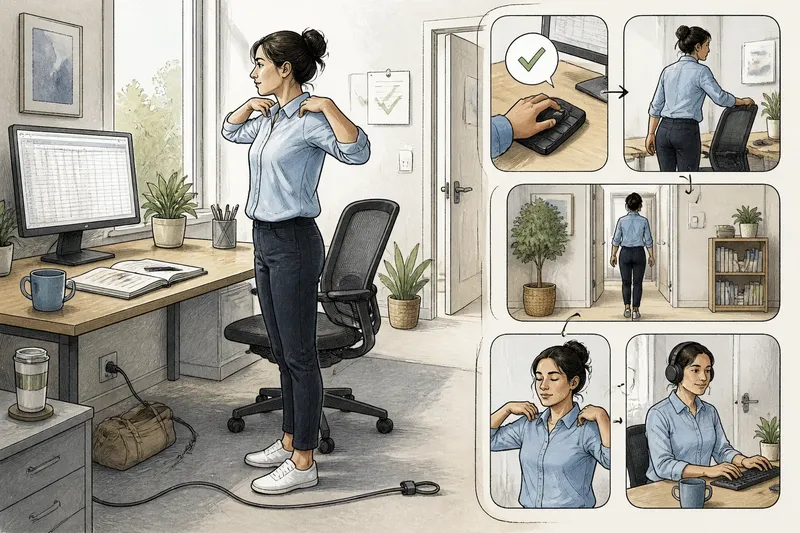
A short movement break between desk tasks works best when it has a clear cue and a practical endpoint. Imagine Maya, an invented office worker, finishing a spreadsheet review before a video call: she saves the file, stands beside her chair, and uses the transition to reset her workspace and position.
Her challenge is not finding a workout to fit between assignments. It is noticing how the desk setup, task sequence, and next deadline influence whether a brief change of position is easy to begin and easy to finish.
Task boundaries make reliable movement cues
Maya ties her pause to a work event she already recognizes: sending a completed report. That cue is more dependable than waiting for a vague feeling of having been seated long enough, and it avoids interrupting a calculation that still needs attention.
She treats the cue as an invitation rather than a deadline. If a call begins immediately, she starts the next task and looks for another natural transition later; if the report is still unfinished, she waits until she has saved or sent it.
For a useful cue, connect movement to a task that has a visible ending, such as closing a document, sending a message, or finishing a call. The pause then belongs to the shape of the workday rather than becoming a separate item to manage.
A clear route removes friction from desk movement
Before choosing what to do, Maya checks the space around her chair. A bag beneath the desk, a cup close to the edge, or a loose cable across the floor can complicate standing or walking, so she moves only the items that obstruct a safe, ordinary route.
She keeps the monitor, keyboard, and chair in place rather than rearranging the workstation for a quick pause. If the doorway is clear, she can walk there and back; if it is blocked or the room is too tight, she can stand beside the desk or shift her position without traveling.
She does not use a rolling chair or desk edge as a balance aid. If the floor is cluttered or the setup feels unstable, that observation points to an in-place option—or to postponing movement until the path is clear.
A small menu prevents the pause from becoming another task
Maya picks from a short set of options that fit her clothing, available floor space, and comfort: stand, take an easy walk along a clear path, gently move her shoulders, or adjust her seated position and move her hands or feet. She does not need a mat, bands, or a change of clothes.
Each option has a different practical use. Walking works when the route is open; a standing shoulder movement fits beside a crowded desk; seated movement is available when standing does not feel suitable. She chooses one option rather than trying to complete a sequence.
Say Maya has just sent a report, and the call link is ready. She checks that the path to the doorway is clear, stands beside her chair, gently rolls her shoulders, walks to the doorway and back, then opens the call; the observable result is that she has changed position and returned to work without adding equipment or delaying the next task.
Keep the menu short enough to choose from without planning.
Desk movement choices depend on what the room allows
Maya uses specific observations to decide what is practical. If the floor is clear and the next task allows a brief transition, she walks; if the desk area is crowded, she stays in place; if standing is uncomfortable, she adjusts her seated position and moves within a comfortable range.
- Observation: the path from chair to doorway is clear. If it is clear, take an easy walk there and back; if it is blocked, stay beside the desk and change position.
- Observation: a bag or box obstructs the space beside the chair. If it can be moved safely, put it out of the route; if not, choose seated movement and leave the obstacle undisturbed.
- Observation: a cup or other item is near the desk edge. If it is unstable, move it to a secure surface before standing; if it is already secure, leave the desktop alone.
- Observation: standing feels comfortable. If it does, stand and gently move the shoulders or arms; if it does not, remain seated and move the hands or feet comfortably.
- Observation: a cable crosses the walking route. If it can be cleared without unplugging or disturbing equipment, clear it first; if not, avoid the route and choose an in-place option.
- Observation: the next task is starting immediately. If there is no unrushed transition, begin the task and use the next suitable boundary; if there is a brief opening, make one simple position change.
The decisions are deliberately modest: use the space that is available, rather than forcing the room to accommodate a preferred movement.
How should a desk movement break fit a busy day?
What if the next task starts immediately?
Start the task rather than rushing through a movement just to preserve a routine. Use the next natural transition, such as sending a message or ending a call, as the cue.
What if standing feels uncomfortable?
Standing is optional. Adjust your seated position and move your hands, feet, shoulders, or arms only in a way that feels comfortable.
Does a desk movement break need equipment?
The options described here use ordinary workspace and clothing. A clear path helps with walking, but in-place movement does not require special gear.
When should I stop a movement?
Stop if it feels uncomfortable, or if the space makes it difficult to move safely. Choose a comfortable alternative; persistent or concerning symptoms are a reason to seek guidance from a qualified health professional.
Discomfort and workspace hazards call for a change of plan
Maya pays attention to both her body and the room. She avoids forcing a stretch, holding her breath, or leaning on unstable furniture, and stops any movement that feels uncomfortable.
If a path is cluttered, she does not step over cords or move equipment in a hurry. She picks a seated or in-place option, or waits until the area is clear; persistent or concerning symptoms warrant advice from a qualified health professional rather than experimentation during a work break.
The goal is not to produce a dramatic feeling. A change of position is the observable result, and the next task can begin without demanding that Maya feel more energetic or focused.
A short trial can reveal which cue fits the workflow
Imagine Maya wants to choose between a walk and a movement beside her desk. Her starting inputs are a completed report, a clear doorway, a call link ready to open, and a crowded desktop. She saves and sends the report, checks the floor route, stands beside her chair, walks to the doorway and back, then opens the call; the resulting decision is to use the doorway walk after this kind of report when the route is clear.
On another day, suppose the call begins as soon as she sends the report and a cable crosses the route. She starts the call instead of walking, then chooses an in-place position change at the next suitable task boundary; the tradeoff is less travel in exchange for avoiding a rushed transition and an obstructed path.
After trying a cue, Maya can notice whether it fits the work sequence, whether the route stays clear, and which option feels comfortable in her usual clothes. If a walk repeatedly conflicts with calls, she can use a nearby position change instead; if even that interrupts unfinished work, she can wait for a clearer boundary.
Returning to the next task gives the pause an endpoint
Maya ends the break by returning to her desk, bringing the next task into view, and beginning it. That simple handoff prevents the pause from turning into an open-ended detour or another routine she has to manage.
A short movement break between desk tasks is easier to use when its cue, space, and endpoint all match the workday. Choose from what the room allows, let discomfort or hazards narrow the options, and return to the task without judging the pause by how dramatic it felt.