How the Dumbbell Took on Different Roles in Fitness Culture
Explore how dumbbells came to serve different fitness settings, from deliberate strength work to group classes, and learn what their changing role means.
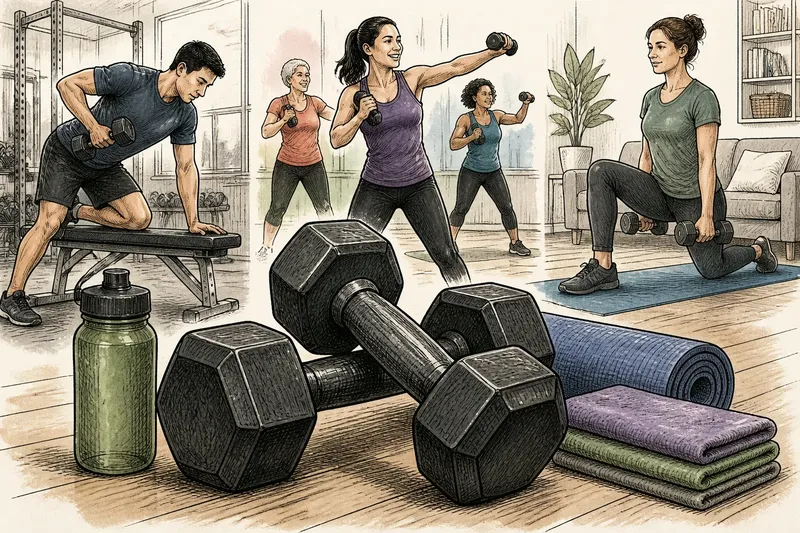
The dumbbell’s place in fitness culture changed as exercise moved through different settings and acquired different purposes. A hand weight could be used for deliberate strength work, repeated movements in a class, or a home routine, and each setting gave the same basic object a different meaning.
Separate hand weights invite separate movements
A dumbbell puts resistance in one hand, so each arm can move independently. A barbell connects both hands to one implement, while a fixed machine guides movement along a set path; those distinctions shape how each tool fits a session.
The dumbbell’s compact form also makes it easy to place beside a mat or store in a closet. But its cultural reach is not simply a matter of portability. Its uses have been shaped by the settings in which people encounter it and the aims those settings emphasize.
Different settings gave dumbbells different meanings
In strength training, dumbbells can add resistance to pressing, rowing, and curling. In group exercise, lighter hand weights may accompany repeated movements set to music, making them part of a shared sequence rather than a test of maximal strength.
Home exercise gives the object another role. A pair beside a mat can signal a planned routine, but it may also be used in an improvised session. The setting changes the expectation: a dumbbell might suggest focused lifting in one place and general movement in another.
These uses should not be collapsed into one story of progress. A movement class, a strength program, and a clinician-guided exercise can all involve dumbbells, yet their purposes and ways of organizing movement differ. The object alone cannot explain the activity.
A familiar tool does not define the training
A dumbbell in a class does not automatically mean the session is strength training in the sense of a progressive lifting program. Nor does adding a weight make an unweighted movement inherently more useful. The added load changes the demand; the activity’s purpose determines whether that change makes sense.
Say you have a light pair at home and follow a video that combines arm raises with marching. If the arm raises make your shoulders tense or interrupt your balance, set the weights down and continue marching. The expected observable result is a more coordinated march without the extra resistance, while the session keeps its movement focus.
When a dumbbell appears in a routine, look at the movement, pace, and stated aim before deciding what kind of exercise it represents.
What do dumbbells mean in different exercise settings?
What does a dumbbell offer that a barbell does not?
Each hand holds a separate weight, allowing the arms to move independently and making the implement easier to position in a confined area. A barbell links both hands, which suits some bilateral lifts but calls for a different setup.
Are dumbbells only used for strength training?
No. Dumbbells may appear in conditioning classes, general movement sessions, and selected rehabilitation exercises. Their presence indicates added resistance, not a single training goal.
Why do dumbbells appear in home workouts?
Their compact form allows them to be stored without a large frame or permanent installation, and they can accompany different movements. A home routine still needs to suit the person and the activity rather than treating one pair as appropriate for every purpose.
How do adjustable dumbbells differ from fixed pairs?
Adjustable designs change load through a selector or removable plates, while a fixed dumbbell stays at one weight. The two styles differ in handling and setup, so the choice depends on how the equipment will be used.
How can you read a dumbbell’s role in a routine?
These details help distinguish a movement class from a strength session or a clinician-guided exercise. If the routine’s purpose or safe use is unclear, pause and ask an instructor or qualified clinician, especially when exercise is part of injury care.
- Check whether the routine names a strength goal; if it does, read the planned resistance work as central to the session, and if it does not, look for the stated movement or conditioning aim instead.
- Check whether the weights are used for deliberate, controlled lifts; if they are, treat the dumbbell as resistance training equipment, and if they are carried through a repeated sequence, consider the class rhythm as part of the activity.
- Check whether the routine gives a specific movement purpose; if it does, assess the dumbbell in that context, and if it does not, ask the instructor what the added load is intended to change.
- Check whether a clinician prescribed the exercise; if so, follow that guidance and ask the clinician about changes, and if not, do not describe the movement as rehabilitation solely because it uses a dumbbell.
- Check whether the load disrupts controlled movement; if it does, set it down or use an easier option, and if it does not, continue only while the movement remains comfortable.
- Check whether an adjustable dumbbell’s parts are secured according to its manufacturer instructions; if they are, use it as directed, and if they are not, stop and correct the setup before continuing.
Familiarity can hide important differences
Because dumbbells are familiar, people may assume the right choice is obvious. In practice, a load that feels manageable for a row may be awkward for an overhead press, and the quality of movement matters more than the tool’s familiar appearance.
For general exercise, choose a load that allows steady, controlled movement and stop if discomfort becomes pain or unusual symptoms. Product instructions matter for adjustable designs; when exercise relates to injury care or rehabilitation, ask a qualified clinician.
Fitness culture often uses objects as shorthand: dumbbells suggest strength, mats suggest stretching, and machines suggest structured training. Those associations can help identify a setting, but they do not determine what a session is for.
The dumbbell’s meaning depends on its setting
The dumbbell has taken on different roles because it can appear in distinct forms of exercise, each with its own pace, purpose, and expectations. Recognizing those differences makes the object less of a symbol and more of a clue about how a session is organized.
When you see dumbbells in a routine, read the movement and its stated aim before assigning it a label. That small distinction helps separate strength work, group movement, and clinician-guided exercise without assuming the equipment tells the whole story.