A Hinge Is a Movement Pattern, Not a Single Exercise
A hip hinge is a way to fold at the hips while the knees stay softly bent. Learn to recognize it in everyday actions without turning it into a workout.
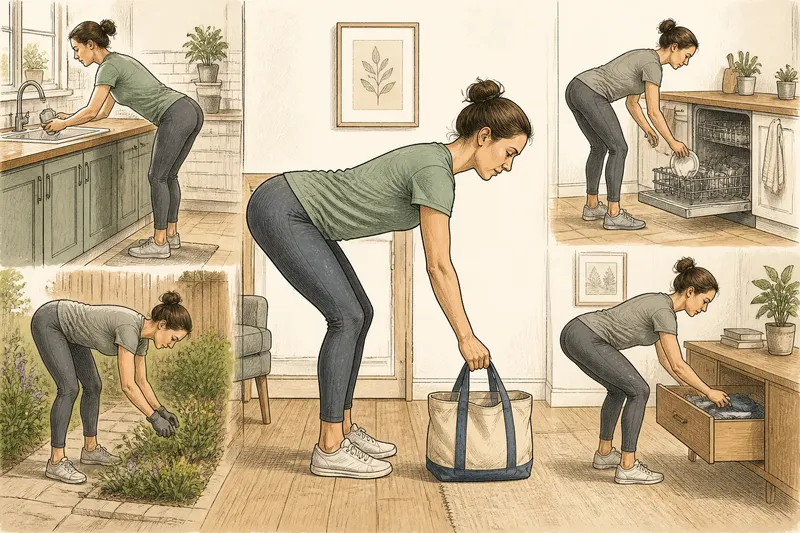
A hip hinge is easiest to recognize when someone reaches their hips backward to pick up a bag, rather than dropping mostly downward by bending the knees. The distinction is not about choosing a better exercise; it is about noticing where a movement is organized. Once you see the pattern, ordinary actions such as leaning over a counter or reaching into a low drawer become easier to describe.
Hip hinge recognition starts with where the torso moves
In a hinge, the pelvis and torso tip forward in relation to the legs, while the hips move back. The knees can bend a little, but their bend is not the main event. In a squat-like action, the knees and hips both bend more noticeably and the body tends to lower between the feet.
These are useful descriptions, not rigid categories. A person reaching for a low object may combine a hinge, knee bend, and a step, depending on its position and their balance. The point is to notice which joint action seems to lead, rather than force a daily movement into one perfect shape.
The torso drops even though the knees barely bend
A common source of confusion is seeing a forward-leaning torso and assuming the movement is a knee bend. The torso can tip because the hips fold, even when the knees remain only slightly flexed. Look at the relationship between the pelvis and thighs: if the hips travel backward as the torso inclines, a hinge is likely doing much of the work.
Say you are reaching toward a tote on the floor beside a chair. If you send your hips back and let your chest angle forward, you may reach it without lowering your whole body very far. If instead your hips descend between your feet and your knees travel forward, the action has more of a squat quality.
Try observing from the side, where the direction of the hips is easier to see.
The knees bend and disguise the movement
A hinge does not require locked knees. Slight knee flexion can make the position comfortable and help the legs share the task; the confusion begins when knee bending becomes the only visible clue someone uses. A quick drop downward can look like a hinge to the person doing it, even when the hips have not moved back much.
To read the action, notice the sequence: do the hips shift backward as the torso inclines, or does the body simply descend? Also notice the feet. In many everyday hinges they stay planted, while a step or a change in stance may be added if the object is off to one side.
Keep the question simple: is the body folding at the hips, lowering through the knees, or combining both?
The back rounds and draws attention away from the hips
When someone bends forward, it is easy to focus only on the curve of the back. Yet a rounded-looking torso does not tell the whole story about the movement pattern: the hips may still be shifting back, or the person may be folding mostly through the spine. From a casual observation, it is often better to describe what you can see than to diagnose why it is happening.
For instance, imagine a person leaning over a sink to rinse a cup. Their hips may remain close to the counter while their upper back rounds, or they may move their hips away and tip the torso as a unit. The task is similar, but the visible contribution from the hips differs.
If a movement causes pain, or a change in bending feels difficult or concerning, a qualified health professional can help assess it in context.
Daily tasks make the pattern easier to spot
Familiar actions are useful because they show that a hinge is a movement pattern, not the name of one prescribed exercise. Reaching toward a dishwasher rack, leaning to pull weeds, and picking up a light parcel can all involve hip flexion, but each also depends on the object’s location, the surface, and whether a person turns or steps.
Watch for these practical clues:
- Hips moving backward: The pelvis travels behind the ankles or heels as the torso inclines.
- Torso tipping forward: The chest angles toward the floor without requiring a deep knee bend.
- Knees staying softly bent: They are not locked, but they do not lead the descent.
- Feet remaining grounded: The stance stays steady unless the task calls for a step or pivot.
- Movement changing with the target: Reaching farther away may call for a larger hip fold or a different stance.
These clues are descriptive, not a pass-or-fail checklist. A person can use a mixed strategy and still complete the task comfortably.
What should you notice when comparing a hinge with a squat?
Do the hips move backward in a hinge?
Usually, yes: the hips travel back as the torso inclines. That backward motion helps distinguish a hinge from a descent led mainly by the knees, though real tasks can blend both patterns.
Does a hinge mean keeping the knees straight?
No. The knees often soften, and their position can change with the task. The useful distinction is whether hip folding or knee bending is more prominent, not whether one joint stays still.
Can one action include both a hinge and a squat?
Yes. Reaching a low object close to the body may involve both sending the hips back and bending the knees. The names help describe emphasis; they do not need to divide every movement into separate boxes.
Is a hip hinge the same as a particular exercise?
No. A hip hinge is a broad movement idea that can appear in household tasks and in many exercise formats. Recognizing it does not mean a person needs to perform a specific drill or adopt a training routine.
Use the distinction to describe movement, not judge it
Movement language is most useful when it makes observation clearer. Saying “the hips moved back as the torso tipped” tells more than calling a bend “wrong,” especially when the task, comfort, and available space all shape how someone moves. A single glance also cannot reveal every reason behind a person’s choice.
When you next reach toward a low shelf, notice whether you lower between your feet or fold forward with your hips moving back. That small observation is enough to make the hip hinge recognizable as a pattern—one that can appear in many ordinary actions without becoming an exercise prescription.